
Wet Ink Notary Services
Acceptable Identification for Notarization in California (2026 Guide)
One of the most common reasons a notarization appointment gets delayed or rescheduled is that the signer brings the wrong identification — or no identification at all. California has some of the strictest ID laws in the nation for notarial acts, and every notary public is legally required to verify a signer’s identity before completing a notarization. Understanding acceptable identification for notarization before your appointment saves time, prevents frustration, and keeps your documents on track.
At Wet Ink Notary LLC, we serve Los Angeles, San Bernardino, Riverside, and Orange Counties as a mobile notary and process serving operation. We follow every requirement set by the California Secretary of State — and in this guide, we break down exactly which IDs qualify, which do not, and what your options are if you don’t have a qualifying document.
What Is “Satisfactory Evidence of Identity”?
Before a California notary public can notarize any document, the law requires the notary to obtain “satisfactory evidence” that the person appearing is who they claim to be. This legal standard is defined in California Civil Code § 1185 and reinforced by Government Code § 8202.
Satisfactory evidence means the notary has no reasonable doubt about the signer’s identity. Unlike many other states, California does not allow a notary to rely on “personal knowledge” — even if the notary has known the signer for years. This is one of the strictest standards in the country. The acceptable identification for notarization must come from either approved ID documents or credible identifying witnesses. There are no exceptions to this rule.
If you’re new to the notarization process in general, our guide on what a California notary public does is a helpful starting point.
Primary Acceptable Identification for Notarization
The 2026 California Notary Public Handbook establishes two tiers of acceptable identification for notarization. The first tier — primary IDs — can be accepted on their own with no additional requirements beyond being current or issued within the last five years.
Under Civil Code § 1185(b)(3), a California notary public may rely on any one of the following primary identification documents:
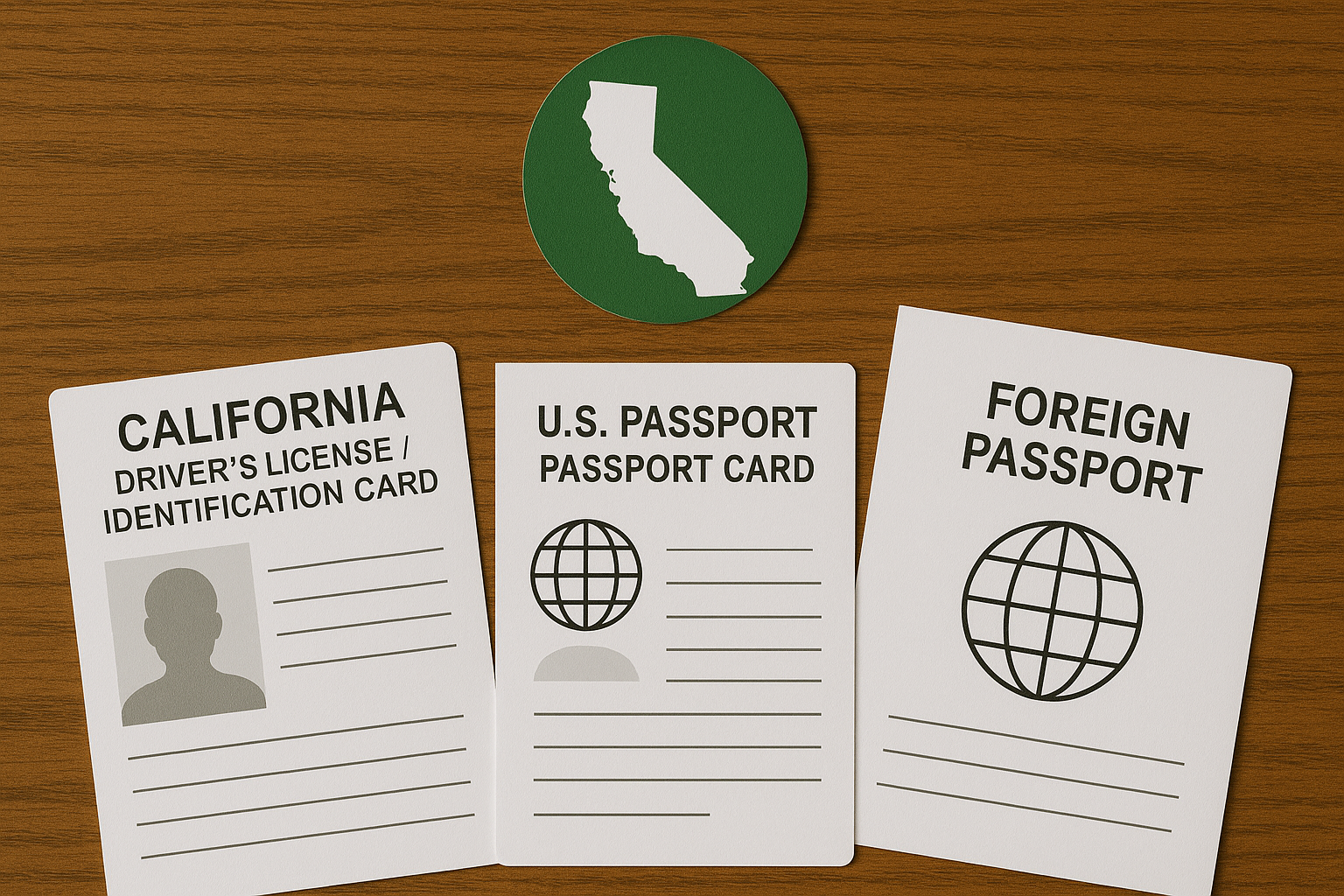
California driver’s license or identification card issued by the Department of Motor Vehicles. This is the most common form of acceptable identification for notarization that signers present at appointments. Both the standard and REAL ID–compliant versions are accepted.
United States passport or passport card issued by the U.S. Department of State. Both the passport book and the smaller passport card qualify as acceptable identification for notarization. If you also need documents authenticated for use overseas, check out our step-by-step apostille guide for the full process.
Inmate identification card issued by the California Department of Corrections and Rehabilitation, provided the inmate is currently in custody in a California state prison.
Any form of inmate identification issued by a sheriff’s department, provided the inmate is in custody in a local detention facility. This category is often overlooked, but it is explicitly listed in Civil Code § 1185(b)(3)(D) as acceptable identification for notarization.
Secondary Acceptable Identification for Notarization
The second tier of acceptable identification for notarization is defined under Civil Code § 1185(b)(4). These IDs carry an additional requirement: each document must contain a photograph, a physical description of the person, the person’s signature, and a serial or identifying number. They must also be current or issued within the last five years.
The following secondary IDs are acceptable identification for notarization in California:
A valid consular identification document issued by a consulate from the signer’s country of citizenship, or a valid passport from the signer’s country of citizenship. Note that a matricula consular card, while issued by a consulate, may not meet all the statutory requirements — the notary must verify that it contains a photograph, description, signature, and identifying number.
A driver’s license issued by another U.S. state, or by a Canadian or Mexican public agency authorized to issue driver’s licenses. This is a frequent scenario for signers who have recently relocated to California but have not yet obtained a California DMV ID.
An identification card issued by another U.S. state. This is the non-driver version of an out-of-state government ID and qualifies as acceptable identification for notarization so long as it meets the photo, description, signature, and serial number requirements.
A United States military identification card issued by any branch of the Armed Forces. Signers should be aware that some current military IDs have transitioned to a format that may not include a physical description, so it is worth confirming your card meets all the criteria before the appointment.
An employee identification card issued by an agency or office of the State of California, or by an agency or office of a city, county, or city and county in California. This is a lesser-known form of acceptable identification for notarization, but it is explicitly authorized under the statute.
An identification card issued by a federally recognized tribal government. This is the newest addition to the list of acceptable identification for notarization recognized under Civil Code § 1185(b)(4)(F).
IDs That Are NOT Acceptable Identification for Notarization
Several common forms of ID do not qualify under California notary law, even though people frequently bring them to appointments. The following documents are not acceptable identification for notarization:
Social Security cards, birth certificates, marriage certificates, credit or debit cards, school or university ID cards, gym or club membership cards, health insurance cards, and any temporary paper license or temporary identification card issued by the DMV. Photocopied, digital, or photographed versions of otherwise-qualifying IDs are also never acceptable.
If you find yourself without proper identification, don’t panic — read our post on what to do if you don’t have your ID but need something notarized for practical alternatives.
Expired ID Rules: The Five-Year Window
Many clients ask whether an expired ID counts as acceptable identification for notarization. The answer depends on when the ID was issued.
Under California law, an identification document qualifies as acceptable identification for notarization if it is either currently valid or was issued within the last five years. This means an expired ID can still work — but only if the issuance date falls within the five-year window. The expiration date alone does not disqualify an ID as long as the issuance requirement is met.
Here is a practical example for 2026: If a California driver’s license was issued on June 15, 2021, and it expired on June 15, 2026, that license is still acceptable identification for notarization through June 14, 2026, because the issuance date is within five years of the current date. However, if the same license was issued on March 1, 2020, and expired on March 1, 2025, it would no longer qualify after February 28, 2025, because the issuance date would be more than five years old.
Key points to remember about expired IDs:
Temporary licenses and temporary identification cards are never acceptable, regardless of their dates. The five-year window is calculated from the issuance date, not the expiration date. If both the issuance and expiration dates are more than five years old, the ID cannot be used under any circumstances. When in doubt, bring a second valid ID to your appointment or ask your notary in advance.
Option B: Credible Identifying Witnesses
When a signer does not have any acceptable identification for notarization, California law provides an alternative: credible identifying witnesses. This option is governed by Civil Code § 1185(b)(1) and (b)(2).
There are two ways credible witnesses can be used:
One credible witness who is personally known to the notary public. Under oath, this single witness must swear or affirm that each of the following statements is true: the signer is the person named in the document; the witness personally knows the signer; the witness reasonably believes the signer is the individual described in the document; the signer does not possess any of the qualifying IDs listed above; and the witness has no financial interest in and is not named in the document being notarized.
Two credible witnesses who are not personally known to the notary. In this case, both witnesses must present their own acceptable identification for notarization to the notary, and both must swear the same oath described above. Both witnesses must also sign the notary’s journal.
Credible witnesses are most commonly used in hospital notarization situations where a patient cannot locate their ID, or in estate planning scenarios involving elderly signers. If you are scheduling a trust signing or power of attorney, always confirm that every signer will have proper identification before the appointment.
Special Considerations for Verifying Acceptable Identification for Notarization
Even when a signer presents a qualifying ID, the notary’s responsibility does not end there. California notaries must follow several additional steps to properly verify acceptable identification for notarization:
Physical examination in person. The notary must physically handle and inspect the original ID document in the signer’s presence. The ID cannot be examined remotely, via video, or from a photocopy. As of 2026, California has not yet authorized remote online notarization (RON) for general documents, so in-person verification of acceptable identification for notarization remains mandatory for traditional notarial acts.
Name matching. The name on the identification document must match or be longer than the name on the document being notarized. For example, if the document to be notarized names “John A. Smith,” the ID showing “John Andrew Smith” is acceptable — but an ID showing only “J. Smith” would not be. This rule protects against fraud and ensures the acceptable identification for notarization accurately reflects the signer.
Checking for tampering. Notaries are trained to examine IDs for signs of alteration, including peeling laminate, misaligned text, inconsistent fonts, and photo substitution. Any ID that appears tampered with must be rejected regardless of the issuing agency.
Maximum fee. California law caps notary fees at $15 per signature for acknowledgments and jurats. Your notary cannot charge extra for the ID verification process itself — it is a standard part of every notarization. For a full breakdown of how to get ready, see our guide on preparing for a notarization appointment.
What Your Notary Must Record in the Journal
Under Government Code § 8206, every California notary public must record detailed information about the acceptable identification for notarization presented at each appointment. The journal entry must include:
The type of identification document presented (e.g., California driver’s license, U.S. passport). The governmental agency that issued the identification. The serial or identification number on the document. The date of issuance or expiration of the document.
For certain documents — including powers of attorney, deeds, quitclaim deeds, and deeds of trust — the notary is also required to take the signer’s right thumbprint in the journal. If you are signing affidavits or sworn statements, the journal entry will still capture all of the ID details above.
This journal documentation exists to create a verifiable record that proper acceptable identification for notarization was established — and it protects both the signer and the notary in the event of a future legal challenge.
Frequently Asked Questions
Can I use a REAL ID for notarization? Yes. A California REAL ID is issued by the DMV and qualifies as a primary form of acceptable identification for notarization, just like a standard California driver’s license or ID card.
Is a green card acceptable for notarization? A U.S. Permanent Resident Card (green card) is not specifically listed in Civil Code § 1185 as acceptable identification for notarization. While it is a federal government-issued photo ID, it does not appear in the exhaustive statutory list. Your best option is to use a U.S. passport or a valid foreign passport alongside it.
Can I use a foreign passport without a U.S. visa stamp? Under the secondary ID tier, a valid passport from your country of citizenship is acceptable identification for notarization provided it contains your photograph, description, signature, and an identifying number. It does not need a U.S. entry stamp for notarization purposes — that requirement applied historically under INS-era rules but the current statute focuses on the document’s own validity.
What if my name has changed since my ID was issued? If you have legally changed your name (through marriage, divorce, or court order) and your current ID does not yet reflect your new name, bring both your current ID and the legal document proving the name change. Discuss the situation with your notary before the appointment.
Does Wet Ink Notary provide credible witnesses? We can help coordinate credible witness arrangements in certain situations. Contact us in advance so we can discuss your specific needs and ensure everything is prepared before the appointment.
Ready to Schedule Your Notarization?
Now that you know which forms of acceptable identification for notarization California requires, you’re ready to book your appointment with confidence. At Wet Ink Notary LLC, we provide mobile notary services and process serving throughout Los Angeles, San Bernardino, Riverside, and Orange Counties — including same-day and 24-hour turnaround service.
Whether you need a trust signing, a power of attorney notarization, an apostille, or mobile notary service for attorneys, bring your qualifying ID and we’ll handle the rest.
Call or text us at (626) 248-0349 to schedule your appointment today.
Wet Ink Notary Services
Service Area
Serving Los Angeles • Orange • San Bernardino • Riverside – Counties
We travel to you for mobile notary and process serving appointments. Coverage includes local, extended, and long-range zones across Southern California.